Indonesian Coffee Export Documents: Importer Checklist
This coffee export documents Indonesia ICO certificate checklist helps brokers clear Indonesian coffee before the vessel arrives.
By Bayu PrasetyoHead of Green Coffee TradingQ Grader (Coffee Quality Institute) with nine years buying, cupping, and contracting Indonesian arabica and robusta for roasters in Europe, Japan, and the Gulf.
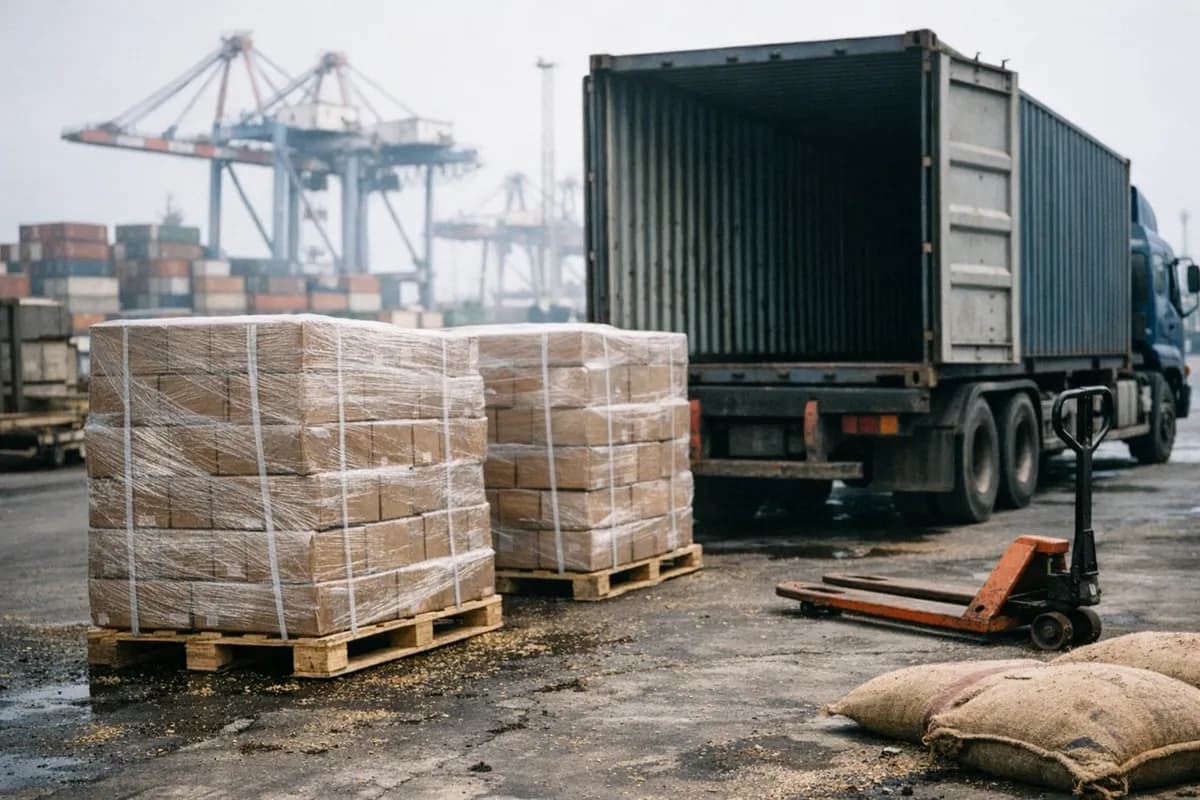
Import clearance starts before the container reaches port. For Indonesian coffee, the broker needs a document set that matches the contract, the bill of lading, the customs code, the certificate requirement, and the destination country’s food or plant rules.
We write this from the export desk. Our job is to prepare coffee and documents so the importer, broker, bank, insurer, and warehouse all read the shipment the same way. The ICO certificate is one part of that file, but it is not the only document your broker will ask for.
What documents ship with an Indonesian coffee container?
A broker should receive the commercial invoice, packing list, bill of lading draft or final bill, ICO certificate of origin where applicable, phytosanitary certificate if required by the destination, and any certification transaction certificate agreed in the contract. The exact file depends on product form, destination country, Incoterm, and certificate claims.
For unroasted coffee, our Indonesian green coffee beans ship under HS code 0901.11. Our green coffee Incoterms are FOB, CFR, or CIF, so the invoice must state the named port and the cost responsibility clearly. A mismatch between “FOB Indonesia” in the purchase order and “CIF destination port” in the invoice can slow a bank check or customs entry even when the coffee itself is correct.
For roasted coffee, the HS code in our product facts is 0901.21. Our roasted coffee lines use FOB, CIF, or DAP depending on the product. Roasted coffee documentation can also include food-label, shelf-life, private-label, or packing declarations if the importer’s market requires them. That is separate from the green coffee ICO workflow.
The practical broker file usually has these records:
- Commercial invoice, with seller, buyer, contract reference, coffee description, HS code, net weight, gross weight, bag or carton count, unit price, total price, Incoterm, and named port or place.
- Packing list, with bag count or carton count, net weight, gross weight, marks, container number once loaded, and seal number once sealed.
- Bill of lading, with shipper, consignee or order party, notify party, vessel, voyage, port of loading, port of discharge, container number, seal number, and freight term.
- ICO certificate of origin for coffee origin reporting where used by the shipment.
- Phytosanitary certificate when the destination authority requires plant-health clearance.
- Certification transaction documents when the contract sells certified coffee, such as Organic, Fairtrade, Rainforest Alliance, 4C, Halal BPJPH, or ISO 22000 covered supply.
- Quality or grading sheet when the buyer needs SNI grade, moisture, screen, defect count, or cup record before arrival.
We prefer to review the required document list before booking. If your customs broker has a country-specific template, send it with the buying brief through our contact page so we can check it before the contract is issued.
What is an ICO certificate of origin for Indonesian coffee?
An ICO certificate of origin is a coffee shipment document used to identify the origin and shipment details of exported coffee under the International Coffee Organization system. It supports coffee trade statistics and origin traceability, but it is not a plant-health certificate, customs duty preference certificate, or quality certificate.
The International Coffee Organization publishes its rules for coffee certificates of origin under its statistical system. In practice, the certificate connects the shipment to an exporting country, exporter, consignee, coffee type, quantity, destination, and transport details. Your broker may ask for it because coffee is a commodity with its own international reporting structure, not because it replaces ordinary customs paperwork.
Importers sometimes confuse three different documents:
The ICO certificate of origin identifies the coffee export as coffee from a producing origin for ICO reporting purposes.
A preferential certificate of origin, when applicable, supports tariff treatment under a trade agreement or national preference scheme. Your broker must confirm whether your market needs one and which form applies.
A non-preferential certificate of origin may be requested for customs, banking, or buyer policy reasons even when no tariff preference is claimed.
These documents can refer to the same shipment, but they answer different questions. One supports coffee trade reporting, one supports tariff treatment where applicable, and one supports origin declaration for customs or commercial purposes. If your broker simply writes “CO required,” ask which kind of origin certificate they mean.
The ICO certificate should match the invoice and packing list on product description, net weight, destination, and shipment reference. For green coffee, the HS code we use in our product facts is 0901.11. If the shipment is roasted coffee, the code changes to 0901.21, and the document need may differ by destination.
Do I need a phytosanitary certificate for green coffee?
You need a phytosanitary certificate when the destination country’s plant-health authority requires it for the coffee form, origin, and import use. Do not treat it as interchangeable with the ICO certificate, because the phytosanitary certificate is about pest and plant-health compliance.
Green coffee is an agricultural product. Some importing countries require a phytosanitary certificate for green coffee, while others may treat processed or roasted coffee differently. The rule is not decided by the exporter alone. It comes from the destination authority and should be checked by the importer’s broker before shipment.
The certificate wording matters. A destination may require a specific additional declaration, treatment statement, inspection statement, or absence claim. If that wording is needed, we need it before the document is prepared. A late request after loading can create avoidable delay because the certificate must correspond to the inspected shipment and its export file.
Roasted coffee has a different risk profile from green coffee, but it still enters under the food rules of the importing market. If your order is roasted, ask the broker which food import records are needed in addition to the commercial invoice, packing list, and transport document. Our wholesale roasted Indonesian coffee range uses HS code 0901.21, and its documentation should be checked separately from green coffee.
A broker should confirm at least four points before we load: whether the phytosanitary certificate is mandatory, the exact consignee and notify details, any required declaration text, and whether the certificate must show container and seal numbers. Those fields affect timing because some details are only final after loading.
How do certification transaction certificates work?
A certification transaction certificate links a certified coffee sale to a specific seller, buyer, product, volume, shipment, and standard claim. It is separate from the ICO certificate and must be requested only for coffee that is actually contracted under that certification.
Our product facts show different certification coverage by origin and product. For example, some Indonesian arabica lines list Rainforest Alliance, Organic EU/NOP, Fairtrade, ISO 22000, or Halal BPJPH. Several robusta lines list 4C, Rainforest Alliance, ISO 22000, or Halal BPJPH. The certification named in the purchase order must match the product line that carries it.
The transaction document is not a decorative attachment. It protects the buyer’s chain-of-custody claim. If a roaster or manufacturer will sell the coffee onward as Organic, Fairtrade, Rainforest Alliance, or 4C, the downstream audit trail usually needs a transaction record or platform confirmation that matches the shipped volume. If the contract is for conventional coffee, that transaction record normally does not exist.
The main buying mistake is asking for certification after price agreement without stating it in the original specification. Certified volume can have different availability, segregation, documentation cost, or shipment timing from conventional volume. If certification is a must-have, write it into the first request for quotation along with origin, grade, quantity, Incoterm, and destination port.
For an offer comparison, start from the coffee line rather than the certificate name. A buyer looking for certified Bali arabica should review Kintamani Bali Arabica Green Coffee Beans, while a buyer comparing certified robusta for industrial use may start with the broader Indonesian robusta range. Then ask us to confirm what transaction documentation can be issued for the exact lot being quoted.
Coffee in this article
Kintamani Bali Arabica Green Coffee Beans
Washed Kintamani arabica from subak abian cooperatives, Organic and Fairtrade, offered in grades 1 to 6.
Organic (EU/NOP) · Fairtrade · ISO 22000
View specificationsWhat is on a green grading sheet?
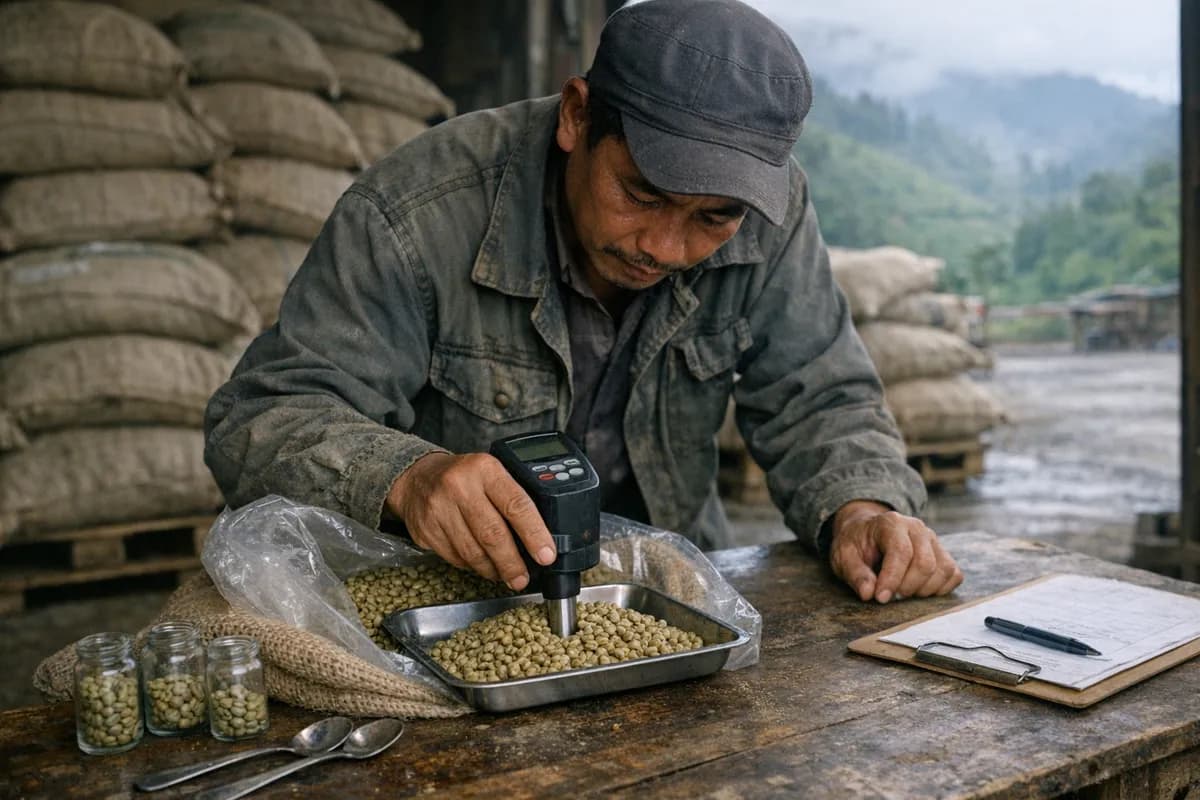
A green grading sheet records the physical and quality checks behind the lot, usually including origin, species, process, grade, sample weight, defect result, screen, moisture, odour, appearance, and cup note where cupping is part of the specification. It lets the buyer compare the shipped lot against the contracted standard before the container arrives.
For Indonesian green coffee, SNI 01-2907 is the relevant grading reference in our product facts. The Indonesian National Standard SNI 01-2907 grades green coffee by defect value in a 300 g sample, with Grade 1 at 0 to 11, Grade 2 at 12 to 25, Grade 3 at 26 to 44, Grade 4a at 45 to 60, Grade 4b at 61 to 80, Grade 5 at 81 to 150, and Grade 6 at 151 to 225. If a sheet says only “Grade 1” without the sample basis or defect result, ask for the detail.
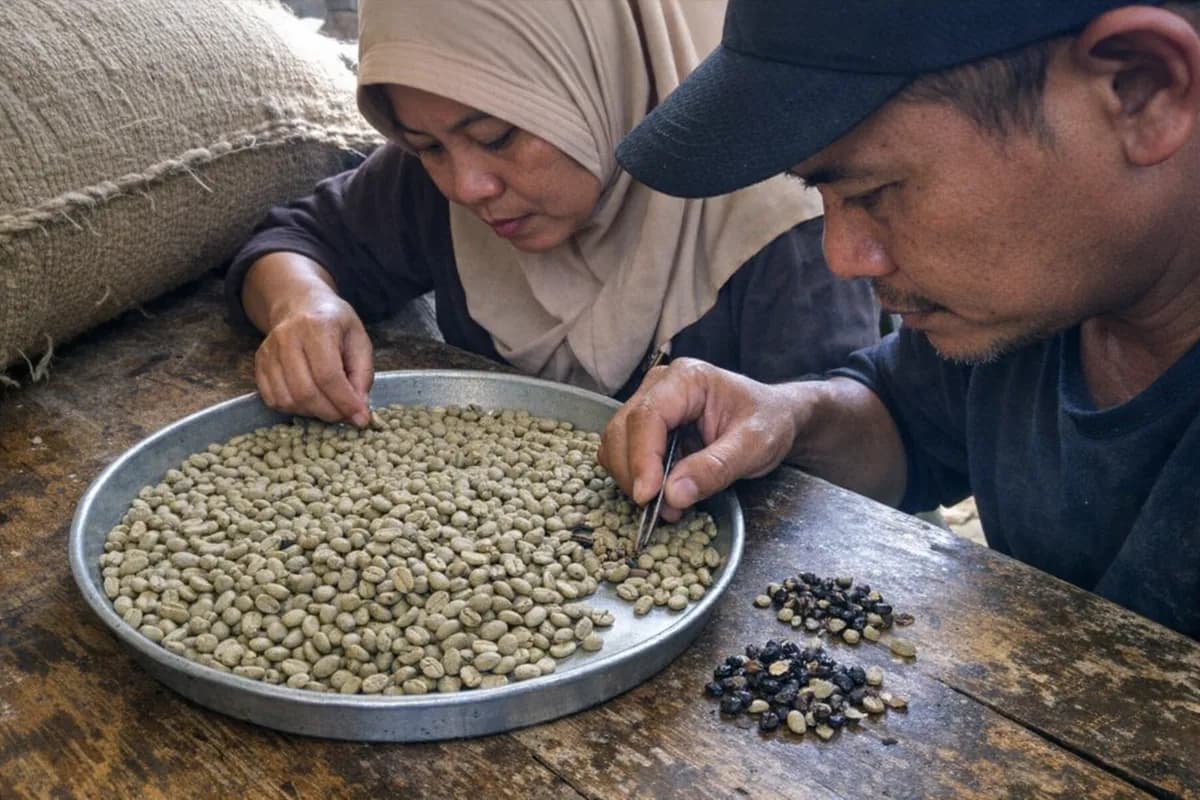
The grading sheet should also state the moisture method or instrument where relevant. Our arabica product facts use Sinar or oven verification for the listed moisture ranges, while our robusta product facts state maximum moisture bands by origin. Moisture is a receiving issue, not just an export issue, because high readings can affect warehouse acceptance and insurance discussions.
Screen should be shown where the contract includes it. A screen 16 up arabica and a screen 18 up arabica are not the same commercial line. For robusta, screen 13 up and screen 16 up also serve different manufacturing uses. A broker may not care about screen, but the factory will.
Cup records belong in the file when the purchase is quality-led. Our Grade 1 arabica product sheets publish cup-score ranges under the SCA cupping protocol, such as 84 to 86 points for Gayo Sumatra Grade 1 and 85 to 87 points for Toraja Sulawesi Grade 1. For robusta, many industrial buyers put more weight on defect count, screen, caffeine range, and roast or extraction performance.
If your internal intake form uses its own defect categories, send it before shipment. We can then align the pre-shipment quality sheet with the fields your receiving team will check.
How should the broker file be checked before the vessel arrives?
Check the broker file by matching every document against the contract line, then against the transport record. The coffee description, HS code, weight, bag or carton count, Incoterm, origin certificate, phytosanitary certificate, and certification documents should tell the same story.
Start with the commercial invoice. Confirm the buyer name, consignee details, HS code, Incoterm, price basis, and destination. Then compare the packing list against the bill of lading for container number, seal number, package count, and net weight. A small spelling difference in the consignee name can create more delay than a quality note if the bank or customs system rejects it.
Next, separate certificate checks by purpose. The ICO certificate supports coffee origin reporting. The phytosanitary certificate supports plant-health entry if required. The certification transaction certificate supports a certified supply-chain claim. A grading sheet supports quality acceptance. None of these documents replaces the others.
Finally, check timing. Some documents can be drafted before loading, but final container and seal details are only known after stuffing. If your market requires originals before vessel arrival, tell us the courier deadline or electronic submission deadline at contract stage. Our practical workflow for green coffee import is also covered in our Indonesian green coffee import guide.
A clean Indonesian coffee import file is built before the container doors close. Agree the coffee, fix the Incoterm, confirm the certificate requirements, and give the broker the draft documents early enough to correct them before arrival.